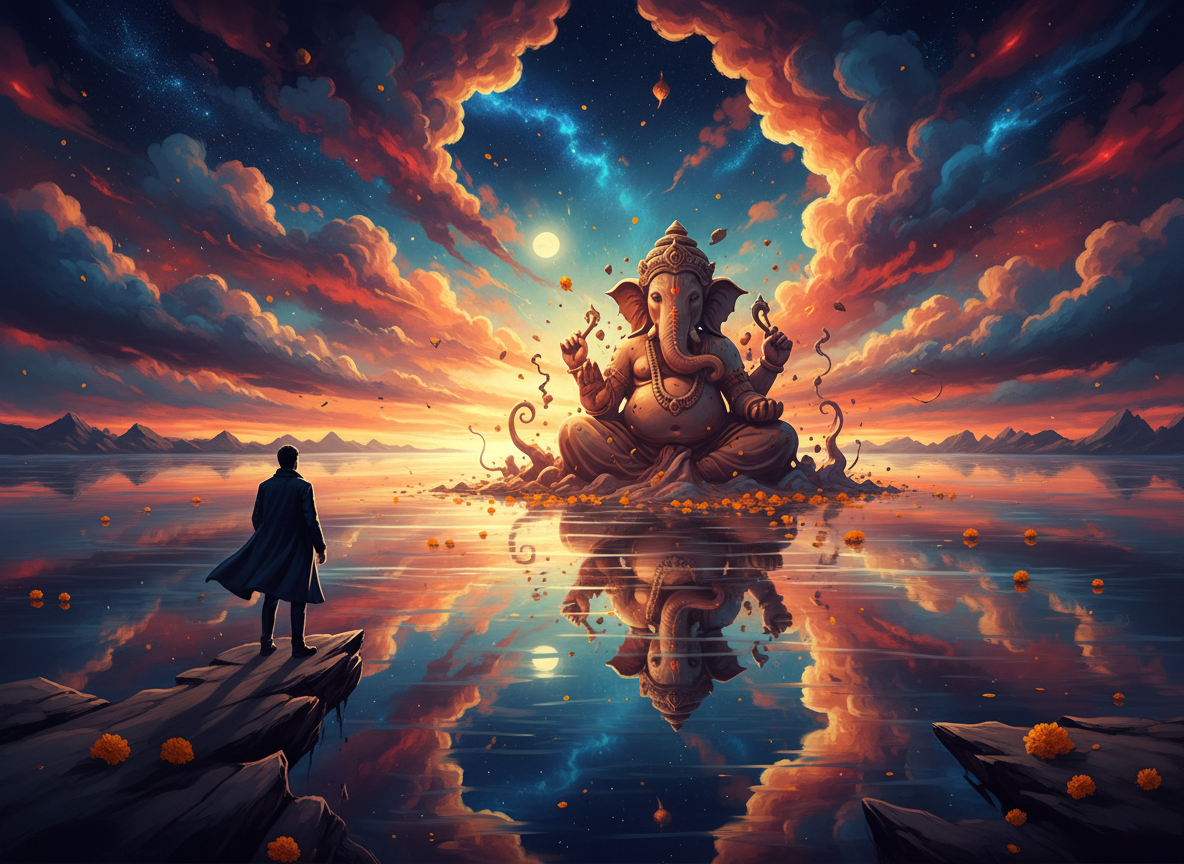
On rhythm, faith, and the strange joy of saying goodbye to a god made of mud
8 min read
The words Ganesh Visarjan bring back two very distinct memories for me.
The first is from when I was five years old. We had gone to my grandmother and uncle’s house for the celebrations, and this was the year my uncle decided that this five year old kid needed to dance his heart out and take a dip at Tank Bund. I was fine with the dancing part. There were two other cousins with me, and one baby cousin sitting on top of my big uncle, waving his hands. We danced for what felt like an eternity, jumping our little hearts out. Then my younger uncle said, “OK, it is time for all the kids to get into the truck behind the idol.” That probably should have been the first sign that something was going to happen. So we danced all the way to Tank Bund. Then came the crane to take Ganesha into the water, and my uncle told me to get into the crane. In a five year old’s mind, this meant only one thing: I am going to help my uncle put a ten foot idol into the water. In hindsight, that was just a little kid being optimistic. Suddenly the crane started moving towards the water, and little Ajitesh started screaming, “Kishore Mama, I am going to drown! I am going to drown!” My uncle just said, “Nothing will happen. Shut up and dance.” So I did.
Flash forward to the second memory. I was in 12th grade, and it was Visarjan again. Being part of the IIT/BITS study group meant we were in school even during the celebrations. It also meant nobody was really paying attention in class, so a couple of us decided to bunk. We got out of school without anyone knowing and went up onto a bridge that had been closed off. From there, we had a view of hundreds of ten foot tall idols making their way to visarjan. Imagine standing on a closed bridge with hundreds of ten foot Ganeshas passing right below you. It is not an image you will ever forget.
Two memories, years apart. In one I was right in the middle of it, and in the other I was watching it from above. Only now have I started asking what all of it actually means: why the clay, why the water, and why everyone dances the way they do.
Made From Earth
Most of us know the story. We heard it from our grandparents long before we ever read it anywhere.
Goddess Parvati wanted to take a bath and needed someone to guard the door. So she made a boy from the paste she used while bathing, gave him life, and told him not to let anyone in. Then Lord Shiva came home. The boy did not know who he was and would not let him pass. In his anger, Shiva cut off the boy’s head. When Parvati saw what had happened, she was heartbroken, and to make it right, Shiva brought the boy back to life with the head of an elephant. That boy was Ganesha.
Now keep in mind, this is only one version. The Puranas tell his birth in a few different ways. But this is the one most of us grew up with, and there is something in it that is easy to miss. Ganesha was not born. He was made, shaped by his mother’s hands. Maybe that is why, for generations, we have brought him home the same way. Made by hand, out of clay.
And then, after a few days, we take him to the water and let him go.
When you think about it, it is a strange thing to do. We bring him home, do aarti morning and evening, offer him modaks, treat him like family, and then we leave him in a lake. But that is the whole idea. Whatever takes a form has to give it up one day. The clay came from the earth, and it goes back to the water. We are allowed to love him and celebrate him, but we are not meant to hold on to him. Every year, the festival teaches us to let go.
Why The Body Cannot Stand Still
Now many people looking in from the outside do not understand how millions of people can dance, almost in sync, to the loud beats of the dhol tasha pathaks. To someone who has never experienced it, it can look strange, and far too loud to handle. Honestly, I believe it takes people into a kind of trance. When the dhols start beating and the Ganesha songs are playing at full volume, loud enough to possibly damage your eardrums, nobody cares. Everyone is so lost in the beat and the emotion behind the celebration that nobody thinks about anything else. But that is my personal point of view. Let us look at the science.
It turns out a lot is happening inside us. The moment we hear a beat, the parts of the brain that control movement switch on, even if we are sitting still. The brain also releases dopamine, not only when the beat hits but while we are waiting for it, which is why the build up feels almost as good as the moment itself. The bass plays its part too. At a live concert in Canada, researchers found that people danced almost 12 percent more when very low bass was switched on, bass so low they could barely hear it. They were feeling it more than hearing it. And when a crowd starts moving together, researchers at Oxford found that dancing in sync releases endorphins, the chemicals that make us feel good, and makes people feel closer to each other. More than a hundred years ago, the sociologist Émile Durkheim had a name for this: collective effervescence, the rush that comes when a whole crowd feels the same thing at the same time. If you have ever been in a Visarjan procession, you know exactly what he meant.
People also ask why we dance more at Visarjan than when we bring him home. I strongly believe it is because this day carries both: happiness and sadness. Sadness because of the time Lord Shiva severed Ganesha’s head for not letting him into his own home, but happiness too, because we will get to see him again soon, maybe in less than a year. When we were kids, our parents and grandparents told us that even good things come to an end, but that does not mean they will not come back. They will. It just may take some time. And we are not the only people who do this. In New Orleans, when someone dies, there is a tradition called the jazz funeral, also known as a second line. The band plays slow, sad music on the way to the cemetery, and on the way back, the funeral becomes a celebration, with people dancing in the streets behind the band.
Back To The Water
There is a story behind the clay that I did not know until I started writing this. The puja we do on Ganesh Chaturthi is called Parthiva Ganesha puja. Parthiva comes from Prithvi, the earth, and it simply means made of clay. And according to the old stories, even his own mother did this puja. When Lord Shiva went to war against the Tripurasuras, Goddess Parvati was left hiding in a cave. When he did not come back, she began to worry and sat there crying, wondering if something had happened to him. A hunter passing by saw her and went to tell her father, Himavan. He found his daughter, took her home, and told her that if she truly wanted to see her husband again, she should do what everyone does, even Shiva himself. Pray to Ganesha. So she made a Ganesha out of clay and worshipped him. A mother praying to her own son to bring her husband home. And Shiva did come home, having won the war with Ganesha’s blessing. So when we make him out of clay, we are doing what a worried mother once did, with her own hands and a little earth. And when the puja is over, the clay goes back to the water, because, as the old texts say, that is where everything began.
Now coming to the part we do not like to talk about. A lot of the idols we buy today are not made of clay at all. They are made of Plaster of Paris and painted with chemical colours, and they do not dissolve easily. They stay in our lakes long after the festival is over. In 2020, the Central Pollution Control Board brought out guidelines banning Plaster of Paris idols, toxic paints and thermocol, and asking for natural clay and artificial ponds instead. But in 2025, the same board told the Bombay High Court that these guidelines are only advisory. The court then allowed these idols to be made and sold, as long as they are not immersed in natural lakes, rivers or the sea without its permission, and how strictly that is followed depends on the state. In Hyderabad, the Supreme Court once allowed Plaster of Paris idols into Hussain Sagar only as a last chance, and only because they would be lifted out by crane right after. At the same time, I do not think a ban alone will fix this. A lot of families earn their living from these ten days, from the idol makers to the drummers to the people who set up the lights and sound, and any change has to take care of them too. The good news is that things are already changing. In Mumbai in 2024, almost half of the idols immersed after a day and a half went into artificial ponds instead of the sea. More people are going back to shadu clay, immersing the idol in a bucket at home and pouring that water into their plants, and some even bring home seed Ganeshas that grow into a plant after visarjan. If you look at it closely, this is not moving away from tradition. This is how it was done before Plaster of Paris came along. So maybe the question is not whether we should stop celebrating. It is whether we can keep the dancing and the drums, and still leave the lake the way we found it.
The Echo
We build a god from earth, dance him through the streets loud enough to feel in our ribs, and then hand him back to the water. The tradition already knew how to do this gently.
Echos Of My Mind
A journey through thoughts and imagination
Find me here
🌐 Website: echosofmymind.com
💬 WhatsApp Channel: Join the channel
📸 Instagram: @echosofmymindofficial
📺 YouTube: @echosofmymindofficial
📘 Facebook: Echos Of My Mind
💼 LinkedIn: Echos Of My Mind
Leave a Reply